
Posted by the 5 Star Home Improvement team
Fencing is one of those things most homeowners only think about when the old panels blow down in a January storm — and then they want it sorted yesterday. But rush the decision and you can end up with something that looks wrong, rots within five years, or falls foul of planning rules you didn't know existed. The right fence does a lot of work: it keeps kids and pets in, keeps unwanted attention out, and sets the tone for everything else you do in the garden.
This guide covers the main fencing types available to UK homeowners — closeboard, feather edge, trellis, post and rail, and picket — and weighs up timber versus concrete posts. We'll look at what suits different garden situations, run through realistic costs in GBP, flag the planning permission threshold you need to know about, and touch on some specific considerations for gardens in Burton upon Trent, Rugeley, and Swadlincote. No sales pitch — just the information you need to make a decent decision.
The Main Fencing Types Explained Plainly
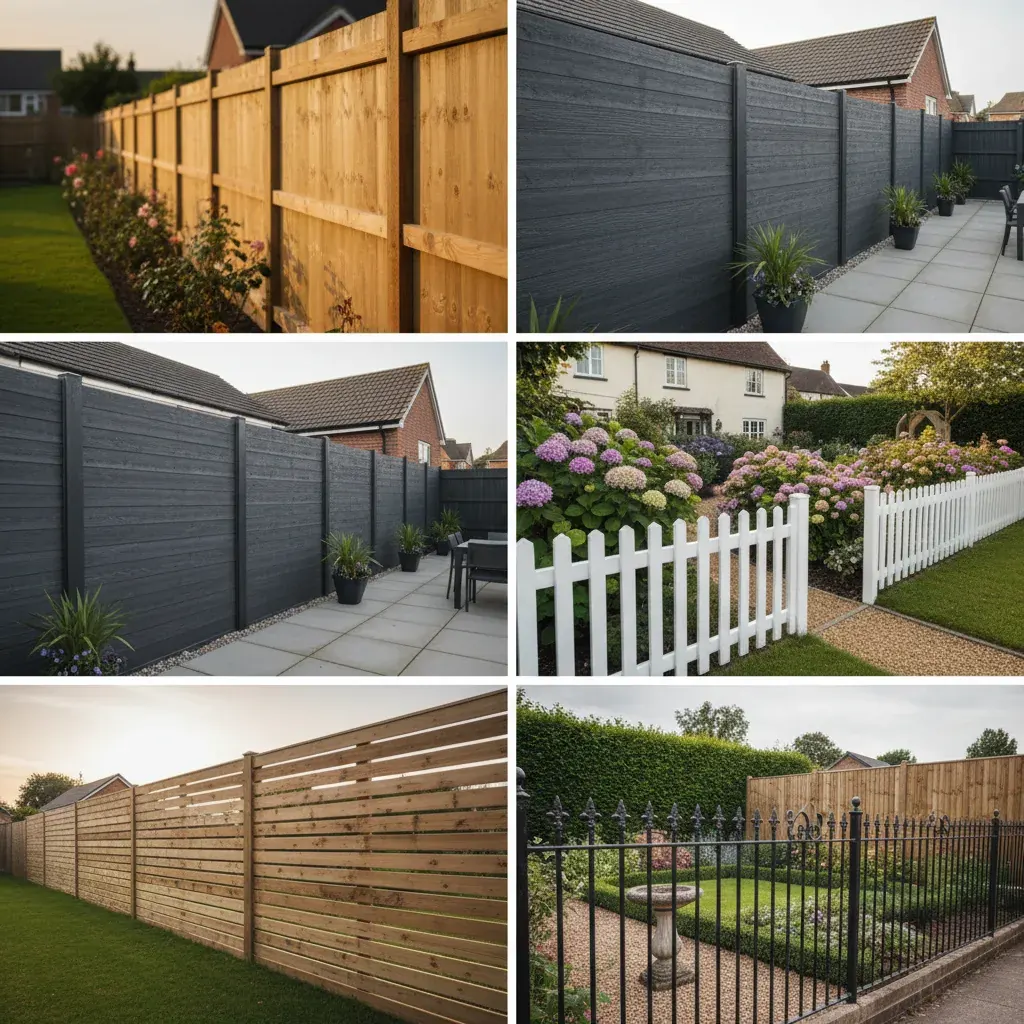
Closeboard fencing — sometimes called feather-edge panel fencing — is the workhorse of UK domestic gardens. Vertical feather-edge boards are overlapped and nailed to horizontal arris rails, creating a solid, wind-resistant barrier with good privacy. It suits most rear gardens and handles the sort of gusts that roll across the Trent Valley in autumn without twisting or collapsing the way flat-sheet panels can. A standard 1.8-metre bay of closeboard typically costs between £70 and £110 for materials alone, depending on timber grade.
Trellis is largely decorative — it's open by design, so don't expect privacy from it on its own. It works well as a topper on a lower solid fence to add height without mass, or as a frame for climbing plants. Post and rail is open and rural-looking, best suited to boundaries between large gardens, paddocks, or properties where you want to mark a line without blocking the view. Picket fencing is the classic front-garden choice: typically 900mm to 1.2 metres tall, it's welcoming rather than defensive and suits period properties like the Victorian and Edwardian terraces you'll find throughout Burton town centre and the surrounding villages.
Timber Posts Versus Concrete Posts — Which to Choose
This is where a lot of fencing installations go wrong. Timber posts, even pressure-treated ones, rot at ground level — usually within 8 to 15 years in UK soil conditions. The post itself can look fine above ground while the base is crumbling away, which is exactly what happens when a fence blows over in the first decent storm. Concrete posts cost more upfront — roughly £18–£30 each compared to £10–£18 for a treated softwood post — but they'll outlast three sets of fence panels. They're particularly worth it in wetter ground close to watercourses, and parts of Burton upon Trent near the River Trent and its floodplain can have persistently damp subsoil that accelerates timber decay.
Concrete posts also accept slotted or morticed panels, which makes future panel replacement straightforward — you slide the old panel out and drop a new one in without digging anything up. The trade-off is weight: they're heavy to handle and need proper setting in postcrete. If you're going for a long run of fencing — say 20 metres or more — the labour saving on future maintenance alone justifies the extra upfront cost.
What Suits Your Garden — Privacy, Pets, and Slopes
Privacy is the most common reason people replace fencing, and for that you want solid panels at 1.8 metres minimum. Closeboard or solid lap panels with a trellis topper can bring you to 2.1 metres without needing planning permission if the fence isn't fronting a highway — more on that below. For dogs, height matters less than gap control at the base: a standard panel fence can have a 50–100mm gap at ground level where soil has shifted or settled, which is enough for a terrier to squeeze through. Specify gravel boards — a horizontal board running along the bottom of the fence line — to close that gap and also protect the panels from ground moisture.
Sloped gardens present a different challenge. You have two options: stepped fencing, where each bay drops in a staircase pattern following the slope in fixed increments, or raked fencing, where the top and bottom of the fence follow the gradient continuously. Stepped panels look neater with panel-based designs; raked fencing works better with on-site-built closeboard runs. Many gardens in Swadlincote and the hillier parts of Burton have significant gradients — if you're not sure which approach suits your plot, it's worth getting a professional to assess the fall before you commit to materials.
Planning Permission — the 2-Metre Rule Explained
In England, under the Town and Country Planning (General Permitted Development) Order 2015, you can erect a fence up to 2 metres in height in your garden without needing planning permission — provided it doesn't adjoin a highway. If it faces a road, the permitted limit drops to 1 metre. Anything above these heights requires a formal application to your local planning authority, which in Burton upon Trent is East Staffordshire Borough Council, and in Swadlincote it falls under South Derbyshire District Council. Applications cost £206 as of 2024 and take around eight weeks to process.
There are also restrictions in conservation areas and on listed buildings — parts of Burton town centre, Tutbury, and Barton under Needwood have conservation area designations where even permitted development rights can be restricted. If you're in any doubt, a quick call to the relevant planning department before you start is far better than having to take fencing down at your own cost.
Maintenance Requirements and Realistic Longevity
Pressure-treated softwood — the standard for most UK fencing — should last 15–25 years in posts and 10–15 years in panels with reasonable maintenance. That maintenance means applying a good-quality timber preservative or fence treatment every 3–5 years, checking for loose fixings after winter storms, and clearing soil and debris from the base of panels to prevent moisture build-up. Products like Cuprinol or Ronseal fence life are widely available and a 5-litre tub covers around 20 square metres — enough for a 10-bay garden fence — at around £20–£25.
Composite fencing is increasingly popular and worth considering if you want minimal upkeep. Made from a mix of recycled wood fibre and plastic, composite boards don't rot, don't need treating, and typically carry a 25-year manufacturer's guarantee. Expect to pay 40–60% more than equivalent timber for materials — roughly £130–£180 per bay installed — but factor in zero maintenance costs over that period and the sums often stack up, particularly for busy households.
Cost Comparison and Local Considerations in Burton upon Trent
Here's a rough cost guide for supply and installation in the Burton upon Trent area in 2024, including posts and labour for a standard 1.8-metre height fence on reasonably level ground: picket fencing at around £60–£85 per metre; closeboard or feather-edge panels at £80–£120 per metre; post and rail at £35–£55 per metre; composite panels at £130–£200 per metre. These are ballpark figures — ground conditions, access, removal of old fencing, and the length of the run all affect the final price. A full rear garden boundary of 15–20 metres of closeboard with concrete posts would typically come out between £1,200 and £2,400 installed.
Gardens in the Burton area have a few specific considerations worth noting. The clay-heavy soils common across much of Staffordshire and South Derbyshire can shift seasonally, which places greater stress on fence posts — deeper setting (at least 600mm, ideally 750mm) and postcrete are essential. Properties close to the Trent — including large parts of Stapenhill, Stretton, and Winshill — have periodically waterlogged ground that accelerates post rot significantly, making concrete posts a near-necessity rather than a luxury. And if you're in a newer estate in Branston or Hilton, check your deeds for any covenant restricting fence height or style before you commit to anything.
In summary
Choosing fencing isn't complicated once you know the variables — but getting those variables wrong costs real money. The wrong post material, an undersized panel for a dog that can dig, or a fence that needs planning permission you haven't applied for: all of these are avoidable with a bit of upfront thought. If you're still unsure which type suits your garden, or you want a straight answer on what it would cost for your specific plot in Burton upon Trent or the surrounding area, 5 Star Home Improvement are happy to chat. We offer free, no-obligation fencing quotes across Burton, Rugeley, Swadlincote, and nearby — just give us a call on +44 7944 852580 or pop us a note through the website and we'll get back to you promptly.
Need a quote or just some honest advice? Get in touch — we're happy to help.