
Posted by the 5 Star Home Improvement team
Every autumn, roofing teams across Burton upon Trent get flooded with calls from homeowners who've left things too late. The first hard frost arrives, a tile slips, water gets in behind the flashing, and suddenly a £300 repair has turned into a £2,000 emergency job with wet insulation, stained ceilings, and a waiting list because every other roofer in the area is fully booked. The Midlands doesn't get the dramatic Atlantic storms that batter the west coast, but East Staffordshire winters are still cold, wet, and windy — quite capable of exploiting any weakness in a roof that's been quietly deteriorating since spring.
This article goes through seven specific warning signs that your roof needs attention before winter sets in — what each one actually means, how urgent it is, and roughly what it costs to sort out. We'll also cover what a proper roof survey involves and why acting in September or October is nearly always cheaper than acting in January.
Why Autumn Is the Best Time to Act
The housing stock in Burton upon Trent is a real mix — Victorian terraces in Horninglow and Winshill, 1960s and 70s semi-detached on the outlying estates, and newer builds in Branston and Stretton. Older properties in particular often have roofs that were last fully replaced 20–30 years ago, and even a roof in reasonable condition will have vulnerable points that winter weather will find. The combination of freeze-thaw cycles, sustained rain, and occasional gusting winds off the Derbyshire hills puts real stress on ageing mortar, cracked tiles, and poorly sealed flashing.
The window between late August and late October is ideal for roof repairs — it's dry enough to work safely, mortar sets properly above 5°C, and you're ahead of the winter rush. Once temperatures drop consistently below freezing, certain repair types become impractical or impossible without specialist materials. Acting now is simply cheaper and less stressful.
Sign 1 and 2: Missing Tiles and Visible Damp Patches
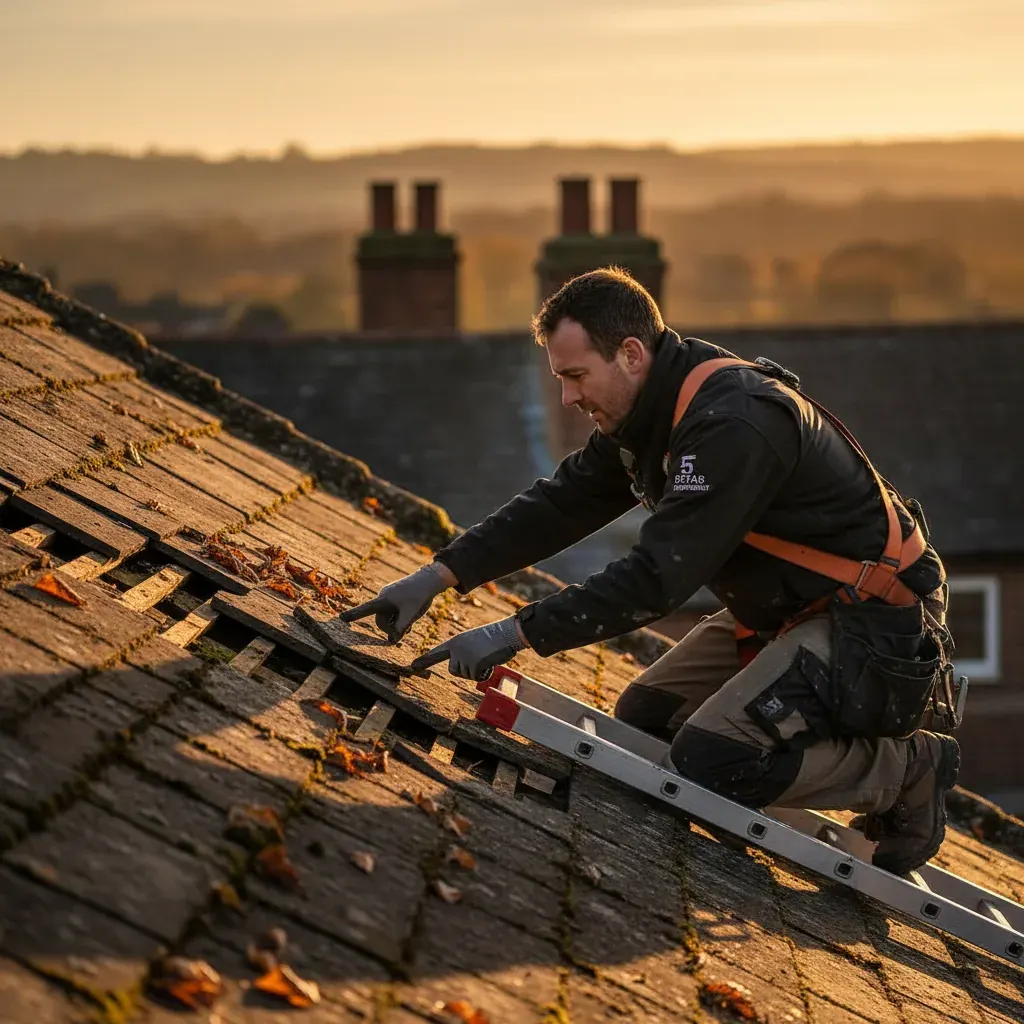
A missing or displaced tile is the most obvious sign something needs doing, and the urgency is high. Even a single missing tile exposes the felt underlay beneath to wind and rain. Older felt — anything installed before the mid-1990s — will typically be bitumen-based and may already be brittle. Replacing a handful of tiles usually costs £150–£400 depending on access and tile type, but if the felt is failing behind it, costs rise considerably. Some older concrete interlocking tiles used widely across Staffordshire in the 1970s are no longer manufactured, which can complicate like-for-like repairs.
Damp patches appearing on bedroom ceilings or on the top floor walls are often the first sign a homeowner actually notices, even though the underlying problem may have been worsening for months. These patches tend to appear or worsen after heavy rain. Don't assume it's condensation — get it checked. A roofer can usually identify the likely source within 15 minutes of inspecting the roof space.
Sign 3 and 4: Cracked Flashing and Sagging Areas
Lead flashing around chimney stacks, skylights, and roof abutments is the most common single point of failure on roofs in Burton upon Trent. Over time, lead expands and contracts with temperature changes, eventually cracking or pulling away from the mortar joint. A repointed and resealed chimney flashing typically costs £200–£500 and takes a few hours. Ignoring it usually means water tracking down inside the chimney breast, causing significant plaster damage internally and potentially affecting structural timbers if left for a full winter.
Any area of the roof that looks uneven, buckled, or lower than it should be is a serious concern. Sagging can indicate waterlogged or rotten roof timbers — a structural issue rather than a surface one. This needs a proper assessment as soon as possible. A small structural repair might cost £800–£1,500 but a badly compromised roof structure can run to £5,000 or more if left until timbers fail completely.
Sign 5 and 6: Moss Build-Up and Daylight in the Loft
Moss and lichen growth is extremely common on north-facing roof pitches across the Midlands — the climate here is damp enough for it to thrive. In itself, a green roof isn't an emergency, but heavy moss retains moisture and can lift tiles slightly as it expands and contracts. On older concrete tiles, this accelerates spalling and cracking. A professional moss treatment and clean typically costs £300–£700 for an average semi-detached, and should be followed by a biocide application to slow regrowth.
If you go into your loft on a bright day and see pinpricks of daylight through the roof, don't ignore them. Any gap large enough to let light through is large enough to let in wind-driven rain. Small gaps around tile edges are sometimes the felt pulling back from the batten — inexpensive to fix now, potentially damaging if water gets into insulation and timbers over winter.
Sign 7: Failed Guttering and What It Costs to Ignore
Guttering doesn't sit inside the typical definition of 'roofing' but it's intimately connected to how well your roof manages water. Blocked, cracked, or sagging gutters cause water to overflow against the fascia and soffit boards — once these rot, the first course of tiles loses its bedding support and the problem escalates quickly. Clearing blocked gutters costs as little as £60–£120. Replacing a run of uPVC guttering on a semi-detached in Burton upon Trent is typically £200–£500 depending on length and access.
The cost of ignoring roof problems almost always exceeds the cost of fixing them early. A £250 tile replacement left for six months can become a £1,800 felt and tile replacement. A £350 flashing repair left over winter can become a £2,500 plaster and timber repair. Get any concerns checked before the clocks go back — a free survey from 5 Star Home Improvement takes less than half an hour and will tell you exactly where you stand.
In summary
Burton upon Trent winters aren't forgiving, and a roof that scraped through last year might not manage another one without attention. The good news is that most issues flagged in autumn are straightforward, affordable repairs — it's only when they're left until January or February that they become expensive emergencies. Our roofing team covers Burton upon Trent and the wider Staffordshire and Derbyshire area, and we offer free no-obligation roof surveys so you know exactly what — if anything — needs doing before the cold sets in. We're not in the business of inflating small problems into big jobs. If everything looks fine, we'll tell you. Give us a call on +44 7944 852580 or pop us a message and we'll get booked in.
Need a quote or just some honest advice? Get in touch — we're happy to help.